
Taking the Argument to Cambridge
ABI's new analysis in Endpoints News says the surest protection is a stronger America. Tomorrow night at MIT, the people who build, fund, and study medicine take up the question.
The surest protection for America's medicine is a stronger America, built at home and extended through allies. That is the argument the American Biosecurity Initiative published this week in Endpoints News, and it is the question an auditorium of biotech leaders will debate tomorrow evening in Cambridge.
The article, "Why America's Medicine Became a National Security Question," opens with a number that describes the past five years better than any policy paper. American pharmaceutical companies once licensed almost none of their new drug candidates from China. Today the share is close to a third. A July 2026 literature review by Start Grow Remain assembles the public record behind that shift, tracing how a country that spent two decades supplying the ingredients in America's generic medicines became a source of the innovation behind new therapies.
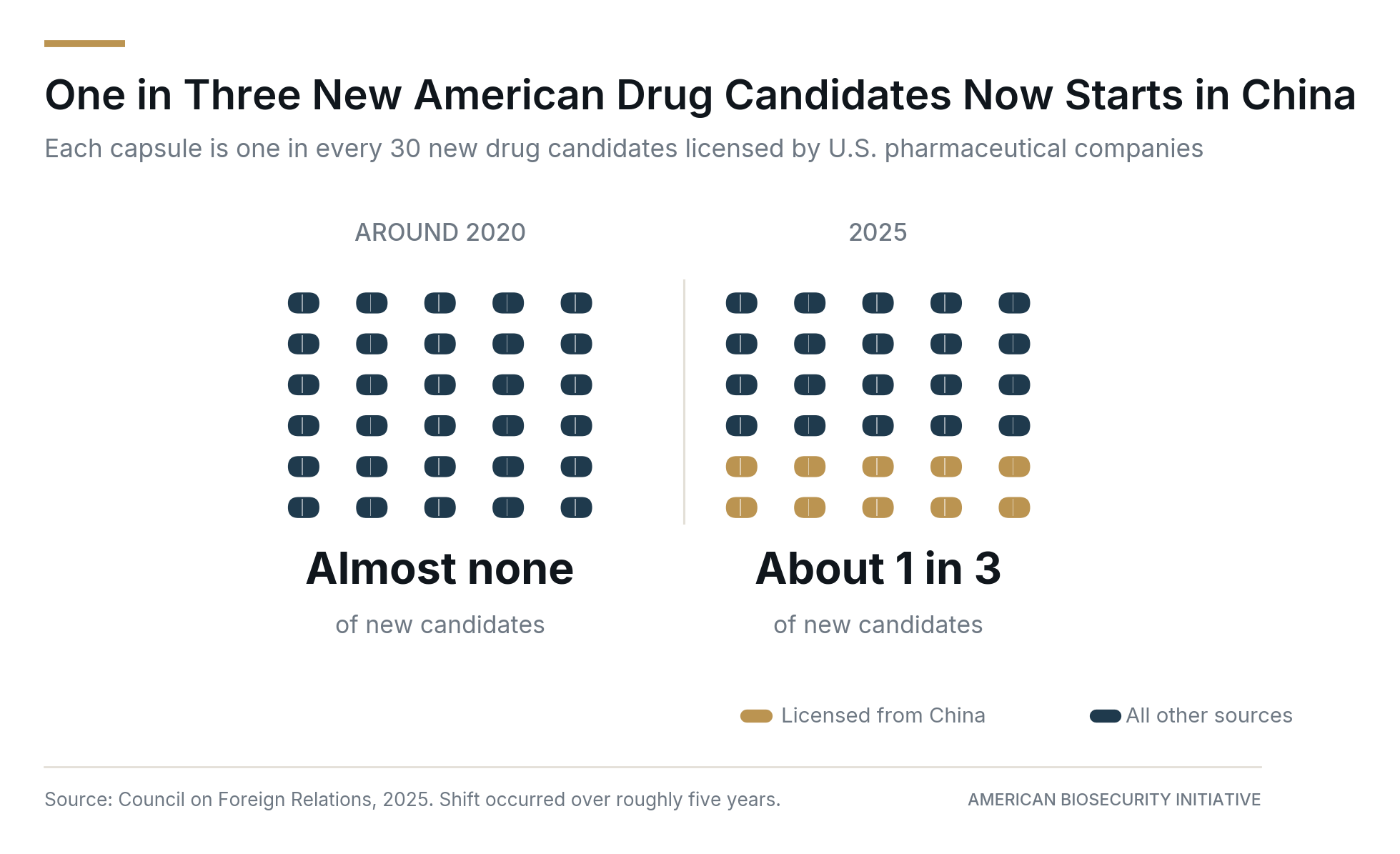
Share of new U.S. drug candidates licensed from Chinese companies, 2021 to 2026.
The record shows a competitor that organized for this outcome. China's Five-Year Plan names biomanufacturing and reduced foreign dependence as explicit priorities. Chinese clinical trial volume reached roughly 120 percent of the U.S. level in 2024, and the Information Technology and Innovation Foundation concludes that China has already passed the United States in certain categories of clinical development. The National Security Commission on Emerging Biotechnology stated the consequence plainly: under current investment trends, the United States will field the biotechnology of the last decade while a competitor fields the next.
The instinct that follows a security framing is often the wrong one. When a rival closes the gap, the reflex is to wall the sector off, and the country has run that experiment before. Export controls placed on Chinese firms in 2007 pushed the targeted companies to raise research spending by 49 percent; the restriction built at home what China had been importing. Protectionism deepens the vulnerability it promises to relieve. Security means growing the domestic base and widening the allied network at the same time, through the machinery America already holds: university research, private capital, and federal science linked more productively here than under any centrally directed model, backed by allies in Japan, South Korea, the European Union, and India who hold real capacity of their own.
“Protectionism deepens the vulnerability it promises to relieve.”
That question goes before a full room tomorrow. Endpoints News hosts The China Biotech Debate at the Koch Institute at MIT on Thursday, August 6, with ABI serving as Executive Sponsor. ABI Executive Director Jennifer Crook takes the stage as featured speaker, followed by debate-style panels bringing together leaders from Roivant Sciences, Ginkgo Bioworks, RA Capital Management, Pfizer, Strand Therapeutics, and MIT Sloan. The panels take up the questions the article raises: what still counts as a defensible moat when promising drugs are quickly copied and raced into trials, how investor incentives square with industrial priorities, and what deepening pipeline ties to China mean for pharma's long-term strategy.
The conversation matters because the answer is still America's to give. The country still discovers more medicine than any other on earth, a position built by open science and private capital moving faster than any planned system could direct them. Extending that lead is a choice, and it starts with treating the capacity to discover, develop, and make medicine as what it is: critical national security infrastructure.
Read the full analysis in Endpoints News.
Event details and tickets.